



The first step is to assess where your profit margin level is now. Bear in mind that profit margin is not a lump sum but a percentage — how much of the revenue flowing through your business is captured. Being profitable doesn’t necessarily mean being flush with cash, as many owners cycle that profit back into growing their business without even realizing it. They might never count this money as profit, so their calculations end up skewed.
Other owners seem to intentionally remain unaware of what number represents their profit, or even how to calculate it. No news is good news, as long as the bills are getting paid.
It’s not a bad thing to admit to falling into either of these camps, as everyone has a different starting point. Business owners are also not immune to cynicism. Many stay so busy that they can’t see how profit margins could possibly be improved — in their mind, that would mean working even harder, and they already feel maxed out. Or they’ve tried many things over the years and nothing worked, so they don’t believe closing the profit gap is something they can control.
Every business owner has reason for hope. Experience has taught us that if you approach this profit gap methodically and with the help of a trusted advisor, you can improve your profit margin and close that gap.
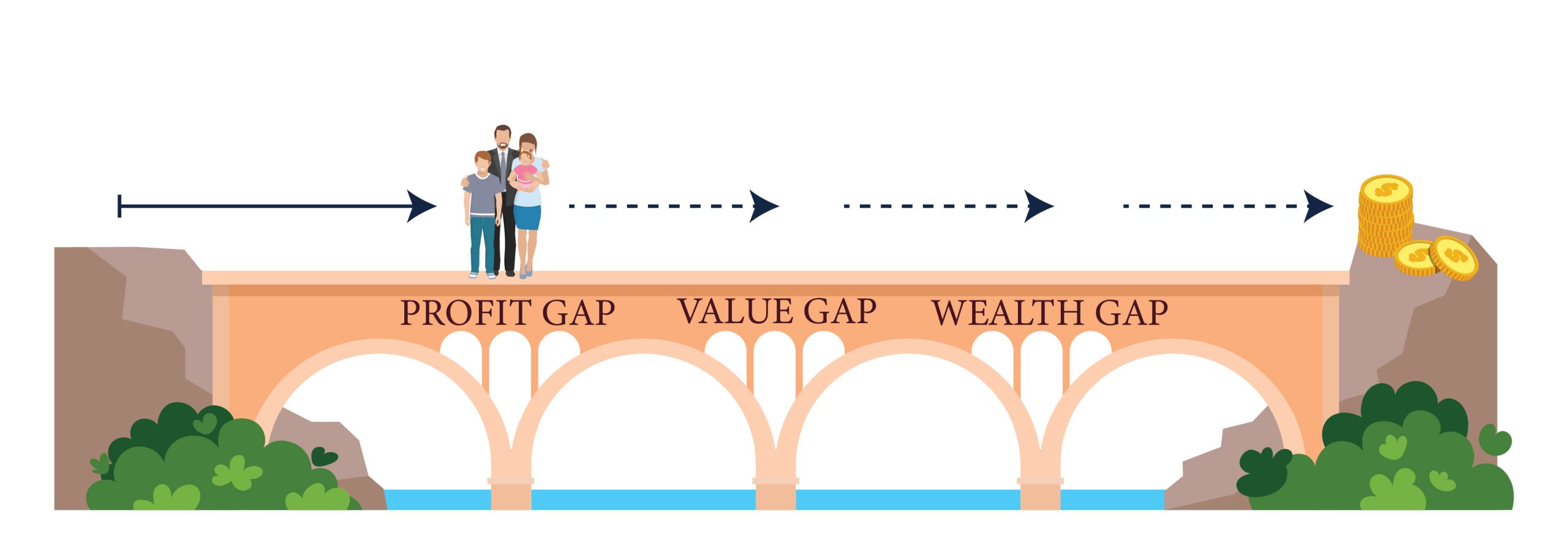
Step two is to find out the profit margin for the best in class in your industry — then, perform higher than that. Remember, industry standards are another way to say “average.”
Step three is to reduce the gap. This involves an examination of:
• Revenue streams (sales, market demand, pricing)
• Expenses (production and operational costs, taxes)
• Efficiency and productivity (waste, supply chain disruption)
• Market competition (how many competitors, what are they offering)
• Economic pressures (inflation, interest rates, spending patterns)
• Regulatory changes (tariffs, trade policies)
There is a limit, and once you reach it your focus shifts to maintenance. With regular workshops, Eagle Corporate Advisors can help you maintain your desired profit margin level while we work to close those other gaps (value, wealth, time). These aspects of your business are all related, of course, though it might surprise you to learn how.
Closing your profit gap is not the ultimate aim, it’s only a piece of the puzzle. Our underlying goal is always to improve the value of your business.
Ken Sanginario, founder of Corporate Value Metrics, points out that profitability should be viewed as a byproduct of a valuable, well-functioning business. He calls out a big mistake many business owners make when they put the cart before the horse in creating value for their company. “They treat revenue and profitability as the inputs to creating value, when in fact, revenue and profitability are the outputs. They’re the byproducts,” he said. “If they treat them as inputs, as direct drivers of value … they end up eroding value. … it’s all of the underlying qualitative attributes that generate the output of the right kind of revenue, the right kind of profit, the right kind of growth. And that’s what creates value.”
