

August 2019 Newsletter

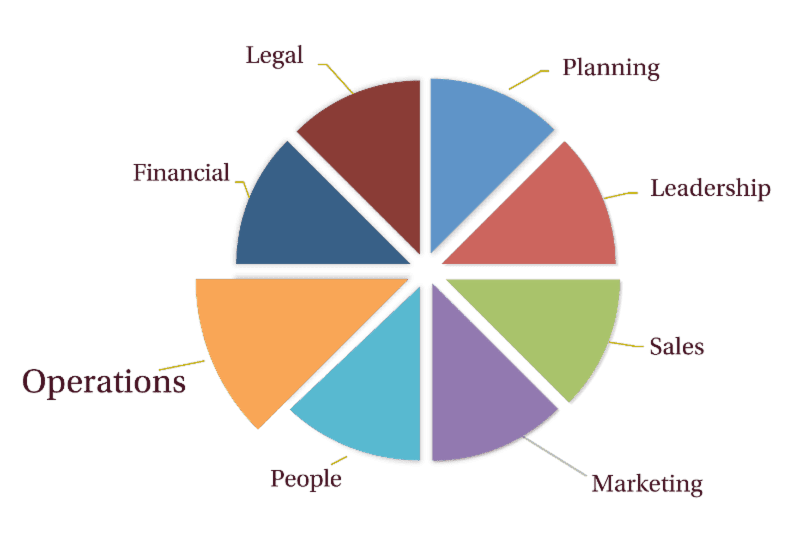
Fundamentals:Operations – Part 1
“Management is doing things right;
leadership is doing the right things.”
– Peter Drucker
“We are what we repeatedly do. Excellence, then,
is not an act, but a habit.”
- Aristotle
What are Operations?
Jobs or tasks consisting of one or more elements or subtasks, performed typically in one location. Operations transform resource or data inputs into desired goods, services or results, and create and deliver value to the customers. Two or more connected operations constitute a process, and are generally divided into four basic categories: (1) processing, (2) inspection, (3) transport, and (4) storage.
(business dictionary website)
The purpose of operations is to manage the resources needed to create your company’s products and services. These may include customer service; planning, designing or engineering products; scheduling work; buying or making components; assembling or manufacturing products; testing quality; maintaining inventory; and delivering the services or products. Operations are also affected by the location, size and type of facilities required and available; worker skills and talent; technology or special equipment; and scalability. When your organization has the systems and processes in place to deliver on the promises made to your customers in an efficient and effective manner, while providing the opportunity to scale up or into new markets, the value of your business increases.
It all starts with an operations strategy to ensure that your resources work together, while aligning with your marketing, finance and overall business strategies. This is a written plan that addresses best practices to ensure that all operational aspects are being utilized properly.
We will discuss your operations plan in more detail in next month’s newsletter.

The Five D’s: Disagreement
“The aim of argument, or of discussion,
should not be victory, but progress.”
– Joseph Joubert
I often talk about the “Five D’s,” as five major events that can create severe disorder in a business. These are:
- Disagreement
- Divorce
- Disability
- Distress
- Death
While none are pleasant to think about, it is imperative that owners have a contingency plan for each to give the business a fighting chance of survival should one or more occur. The good news is there are definite steps within our control that we can use to minimize the negative impact.
The first D, “Disagreement,” can occur with a customer, an employee, a supplier, a vendor, or many others; yet often takes place at the ownership level. Business partnerships are like marriages, and the relationship, even among former friends with the best of intentions, can disintegrate under unrelenting pressures, particularly when money, egos and negative emotions are involved. These kinds of rifts can filter through the entire organization, causing employees to take sides, and can even result in costly lawsuits that cause the company to fail. Don’t say it can’t happen to you. I’ve seen business partnerships reach critical meltdown more than once.
No matter how rosy things my appear now, spelling out intentions, agreements, policies and procedures early, before there’s an issue, is essential in working through potential disagreements over decisions such as reinvesting for growth or taking dividends; how to structure benefits or taxes; when to sell or bring in another investor; and which exit option to pursue.
Depending on your business structure, you will need an operating agreement, partnership agreement or shareholders’ agreement to set expectations and provide procedures to be able to address and resolve these issues effectively. Upon reviewing what you are trying to achieve, using a good business attorney to assist in the process is something I highly recommend so the many dynamics can be articulated properly without later misunderstandings.

Owning a business can be the most exhilarating time of your life. And the most challenging, because working without a net is both thrilling and terrifying.
No matter where you are on the business rollercoaster, Chuck understands those sleepless nights feeling all alone while a million thoughts race around in your head. He knows because he’s been where you are. It’s the reason he started Eagle Corporate Advisors in the first place. To provide just the right kind of coaching, advising and mentoring support for any issue, milestone or decision, to help you and your business perform at a higher level — smoothly and with the best information at your fingertips. And to give you back that sense of controlling your own destiny.